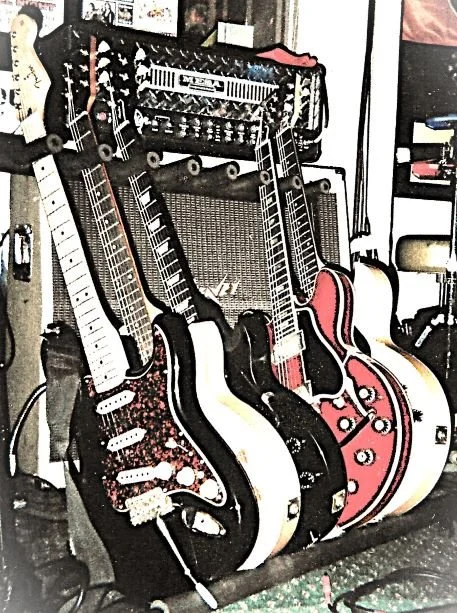
Ain’t No Use in Baitin’ the Hook when You’re Fishin’ in the Drainage Ditch: An Abridged History of My Music Career
I’ve scraped the bottom for a little while But then I’ll brush off my bruises, and I’ll crank out a smile I see the surface, and it’s not too far But no one told me life would be so hard It’s all relative, so they say So, I guess we’re all related in a relative sort of way I’ve got a question, and I’ll pose it to you Just what in the #@$% are we goin’ to do?
The folks who know me well enough to really know me? They know that long before I had any thoughts of becoming an economics professor, I pursued a career as a rock ‘n’ roll musician. I’ve never been shy about it. The truth is that I never had any intention of becoming a PhD energy economist or a professor. This career is what I settled on after my run at rock stardom felt like it had finally come to an end and I walked away from it for good.
While the many people who were along for the ride know the story and lived it with me, the people who only know me as an economics professor (or as Jamie’s husband / Dylan’s dad) generally do not know the full history of my roughly 10-year music career, aside from maybe hearing a brief anecdote or two in casual conversation. Now that I’ve grown older and more secure in my academic career, I finally feel comfortable baring my soul a bit more fully with those of you who weren’t there. If, on the other hand, you were there, even if only for parts of it, then maybe this will be a fun trip down memory lane. After all, there are quite a few characters in this story, and it’s just as much about them as it is about me.
It’s also a story about my favorite music, which I’ve embedded throughout the text as the opportunities allow, in the form of direct references and lyrical snippets with links to YouTube videos of the songs from which they are taken (bold red text indicates a hyperlink to a YouTube video, website, Wikipedia page, or download).
The lyrics at the beginning of each chapter, however, like the verse inserted above, are my own, from songs I’ve written over the years. They’re all available for you to listen to at some point in the journey that follows.
I should also be clear that I’m leaving out all of the NSFW details of the many shenanigans and capers that I and my bandmates and closest friends got ourselves into during those years. I’m not trying to incriminate, embarrass, or otherwise implicate myself (or anyone else) here. We had fun—maybe sometimes a little too much fun. You get the idea. And while there were certainly moments that, if I had them to do over again, I would try to make better choices, on balance I have no regrets. Nor do I have any regrets about walking away from it when I did and transitioning to a different career and life path. It was a hell of a trip, but now I’m quite happy to have a stable life with a loving family. That said, if I hadn’t had the guts to shoot my shot with music, I wouldn’t have found the success I’ve enjoyed in economics.
One practical note before we get going: Below I have embedded several audio files and some YouTube videos of many of the songs that I have written and performed over the years. Most of them are professionally mixed, high-quality recordings. So, if you want the full experience, don’t just listen to them on your crappy little phone or laptop speakers. Get your headphones or plug into a good stereo system (with sub-woofers, so you get that bass)!
Okay. You good to go? Bloody well right, you are.
Chapter 1. Begin the Begin
A ghost appeared within my dream As they sometimes tend to do I stood there crying as she whispered in my ear Oh, you boys, I’m proud of you
My best friends and I were in high school from 1990-1994, which I consider to be the last great burst of mainstream rock ‘n’ roll in America. MTV had emerged in the 80’s as the center of the pop culture universe, and by the 90’s the music industry was throwing off the shackles of overproduced pop and hair metal in favor of edgier and more organic rock. Movies like Wayne’s World and Dazed and Confused captured the rock ‘n’ roll zeitgeist of the moment, which, if you peeked just below the surface, reflected a nostalgic longing to resurrect the 70’s. What characterized the early 90’s was a triumphant blending of the high-octane post-hippie swagger of the 70’s with the mass-market pop sensibility of the 80’s, and it was served to us on the glorious audiovisual platter that was the music video.
The great rock bands of this era are now truly legendary. U2 had catapulted out of Ireland in the 80’s, conquered America, and by the 1991 release of Achtung Baby! had become the biggest band on the planet. Another holdover from the 80’s, Brit emo-rockers The Cure were still breaking goth girls’ hearts well into the early 90’s. But at its most fundamental level, the 90’s was a decade of inspired American musical innovation, driven by MTV’s cultural dominance. White boys of suburbia were having our moment, and the music reflected that. On the West Coast, the grunge scene—led by Nirvana, Pearl Jam, and Soundgarden—was erupting out of Seattle, while Green Day was registering on the Richter scale in San Franciso. L.A. sunsets were oozing with bands like Weezer, Stone Temple Pilots, Jane’s Addiction, Red Hot Chili Peppers, and Rage Against the Machine. In the Midwest, the Smashing Pumpkins were rattling windows in Chicago, while Nine Inch Nails were forging angsty industrial metal in Cleveland. Here in the Southeast, R.E.M. and the Black Crowes were reinventing what it meant to be a southern rock band. And in the Northeast, the Pixies and the Lemonheads dominated college radio stations in Boston, while Ween was getting weird in Philly. Meanwhile, Metallica and Guns N’ Roses were larger-than-life rock gods, aggressively taking heavy metal to the masses without the absurd makeup and hairspray that was the default for hard rock bands of the 80’s. And that’s just the tip of the iceberg. The early 90’s were simply teeming with great artists like Alice in Chains, Beck, Blues Traveler, The Breeders, Counting Crows, Dave Matthews Band, Dinosaur Jr., Faith No More, Fishbone, Flaming Lips, Living Colour, Primus, Radiohead, Sonic Youth, Tool, and so many more, all emerging around this time. Notably, the other culturally relevant phenomenon of the early 90’s is that this was the moment when rap music—led by the likes of Public Enemy, Dr. Dre, Snoop Dogg, Ice Cube, and the Beastie Boys, among many others—absolutely exploded in popularity. It was a great time to be a teenager, and I was convinced that I was put on this Earth to be right in the middle of that rock ‘n’ roll revival.
Around 15-16 years old is when I started to teach myself to play the guitar. My dad had played the guitar as a young dude and still had a couple of his old axes, which I commandeered and started making noise with. I had no idea what I was doing, and I was too arrogant (and maybe a little lazy, too) to think that lessons would do me any good. Instead, I just sat in front of my stereo with my favorite music—pause, rewind, play, repeat—and tried to make it sound like what I heard coming out of the speakers.
It wasn’t long before two of my best friends, Rob Jeter and Jeff Capps, and I were writing songs together. The fourth member of our group, Kris Buranapiyawong (a.k.a. “Dr. B,” a.k.a. “Joe Blow”), did not play an instrument, nor did he ever flip the tape, but he was no less a music fan. [Side note: Our collective favorite band at the time was probably R.E.M., but we each had our own individual tastes, and the four of us each maintained extensive music collections and made an art form out of compiling mixed tapes for each other and our other friends (especially the girls).] The songs we wrote back then weren’t necessarily very good songs. They were mostly silly or corny—basically what you’d expect from high-school boys. But we had a lot of fun doing it. I’m not sure how many songs we wrote together, but it was a decent-sized catalog. The pic on the right (below) is a screenshot from a camcorder video, circa 1993, of Rob and I performing a tune we wrote called “Butterfly of My Soul” (ugh… super cheesy). We thought it was great, but watching the video now, all I can hear is how horribly out of tune my guitar was (which is precisely why you do not get to watch it).
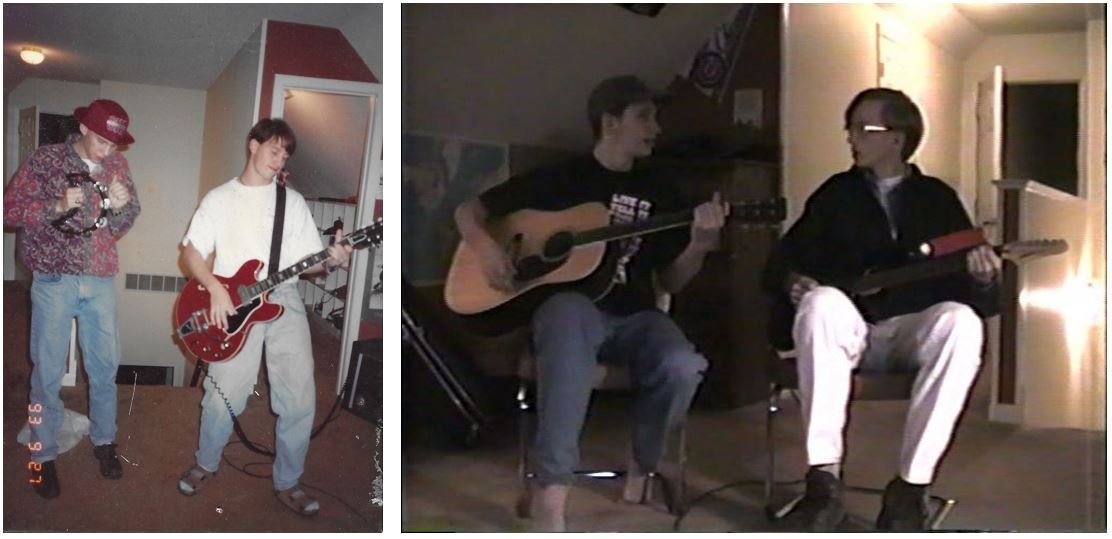
Left: Jamming with Jeff, song unknown, maybe “Loose Socks (What a Pisser)” or “Every Rose Has Its Thorn.” Cool socks and Birks, Bro. (Sept. 1993); Right: Rob and I performing an outrageously out-of-tune rendition of our anthemic masterpiece, “Butterfly of My Soul” (similar date—late 1993-ish).
The four of us—a quartet of smartass GenX children of the 90’s—were collectively bound by music. It was what we lived for. It still shapes our friendship, decades later. When we get together nowadays, we typically build the trip around a good concert. May the wind take your troubles away, gents.
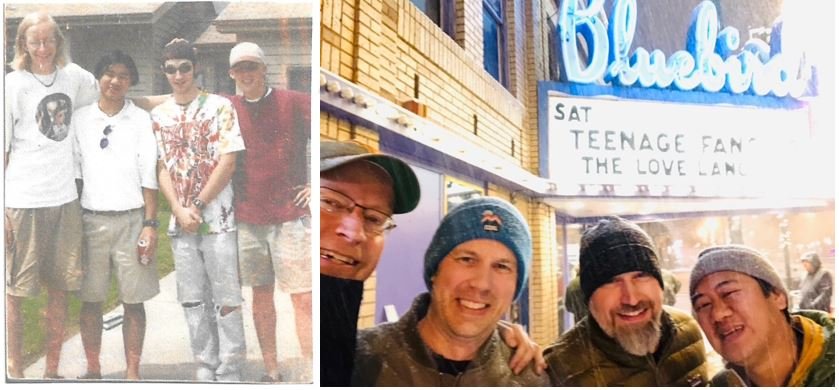
Left: Rob, Kris, me, & Jeff in Naperville, IL (1995). Jeff’s parents had just moved there, so the summer after our first year of college, Rob, Kris, and I took a road trip up to Chicago to visit. We saw Wilco (for our first time ever) at The Vic Theater that Friday night. Right: Seeing Scottish pop-rock darlings, Teenage Fanclub, in Denver (2019).
Chapter 2. SQUIRREL PANTS: My First Real Band
Take a page from history Try to solve the mystery And if you’ve lost because you’ve won You’ll find you’ve only just begun
You read that right. Squirrel Pants was the name of my first band, which I formed at age 18, during my (first) freshman year of college at the University of Memphis, in fall of 1994. My bandmates and I thought that name was hilarious. I don’t remember how it came about.
I was not quite confident enough on the guitar yet to play full-time in a band, so I was the lead singer of Squirrel Pants. (Just that statement alone is ridiculous to read.) The drummer and bassist were guys who graduated from my high school the same year as me, Kris May and T.J. Boland. The lead guitarist, Blaine Lester, was still a senior at my high school, and the rhythm guitarist was my friend Josh Malahy, also still a senior but at our rival high school, whom I knew from church youth group (Josh and I still maintain a solid friendship). We then added the great Patrick Dodd as a third guitarist, also a senior at my high school at the time.
We played at parties, mostly, covering songs like “Girlfriend” by Matthew Sweet, “Hummer” by Smashing Pumpkins, and “Down by the River” by Neil Young, which Patrick sang. It wasn’t long before the band realized that Patrick was a better singer than me and gave me the boot. I was mad at them for kicking me out (I started the band, after all), but for the record, Patrick was a better singer, and I never held any personal resentment toward him for it. He’s a great dude, all around, and went on to have a nice career as a blues-rock singer/guitarist in Memphis and the Southeast. He was even a contestant on NBC’s The Voice in 2012. He was on Team Adam! (I’m not sure I would have been able to turn down Shakira, if faced with the choice myself.)
Chapter 3. Split Open and Melt: Phish Tour (1996-1997)
When they ask where the music comes from All the songs of a broken kingdom They’re supernatural
I first saw the psychedelic jam-rock band, Phish, in June of 1995. I was immediately hooked, and they quickly became my favorite band of all time. By summer of 1996, I had flunked out of the University of Memphis (because I stopped going to class). Can’t this wait ‘til I’m old? Can’t I live while I’m young? I decided to follow Phish on tour. Part of what was endearing about them is that they were so relatable—four nerds who loved music, weren’t glamorous or pretentious, and played whatever the hell they felt like whether people liked it or not (a lot of people did not like it, mainly because they just didn’t get it). Together they became the greatest improvisational rock outfit the world has ever seen, surpassing even the Grateful Dead (yeah, I said it… fight me).
You might wonder how this plays into my music career. Well, it’s because Phish’s guitarist, Trey Anastasio, made me realize that, actually, I sucked at the guitar and needed to put in a lot of work to get better. In ‘95-‘96, when Phish was at the height of their powers, he was like some sort of magical guitar demigod who had tapped into a different plane of consciousness. I pretty much worshipped him, in a nearly literal sense. Phish shows in the mid-90’s were a kind of quasi-religious experience for their throngs of uniquely devoted fans. If you weren’t there, you simply can’t understand what it was like. It was pure joy, distilled. I lost count, but I ended up seeing them in concert over 60 times (there are people who have logged literally hundreds, and probably some who have even broken into four-digit territory).
Around this time, I was also working in restaurants and had moved out of my parents’ house and into a house with some friends in Midtown Memphis. The local music scene was really picking up steam then, led by funk-rock luminaries, Big Ass Truck, who were starting to make waves nationally. I was playing guitar extensively during this time, trying to get better, writing music, and looking for some guys to start a new band with. Turns out one of those guys, Tony Walsh, was already one of my main Phish tour travel companions, but I won’t get ahead of myself. [Fun note: In the Phish YouTube video linked above (“Divided Sky” @ The Clifford Ball, 1996), Tony and I were somewhere out there in that crowd. If you look really closely, you might see us.]
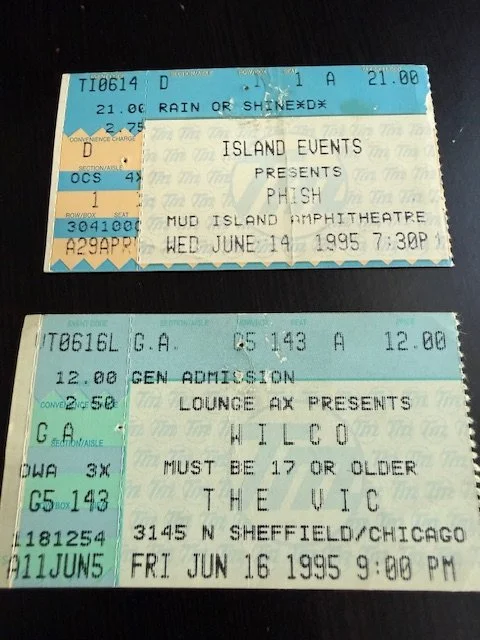
My first time seeing Phish and my first time seeing Wilco (one of my other all-time faves) were a mere two days apart in 1995!
Chapter 4(:20). The Memphis Jones Revolution (1998-2000)
When the boys from the house next door come to play a tune The people all come over and dance while they howl at the moon They’re getting all worked up, and they’re gonna get busted soon
One day in the spring of 1996, I was at a local music shop in Memphis and, as fate would have it, I overheard a guy plinking away on an electric guitar. He was good. I went up and introduced myself to him and asked if he would be interested in getting together to jam. He said yes. His name: Hunter Rozen, who would later become known in our circle as “Flash Gorgeous” or just “Flash” if you were in a hurry. We hit it off and started getting together regularly to jam, but it was nothing serious. He introduced me to some of his friends, one of whom was Tony Walsh. It wasn’t long before Hunter, Tony, and I all became roommates in a little house on Shotwell Street near the U of M. Tony and I spent the next couple years going to Phish shows together, but in the background, we were forming the beginnings of a band.
Then, by chance, in summer of 1998, I ran into a guy I had known from high school church youth group, Nathan Willingham (if you knew him, the irony of us meeting at church should not be lost on you). When I told him what I had been up to, he enthusiastically told me he played keys. I invited him to come jam with us. We also recruited another of Tony’s pals, Ricky Zalamea, to play guitar.
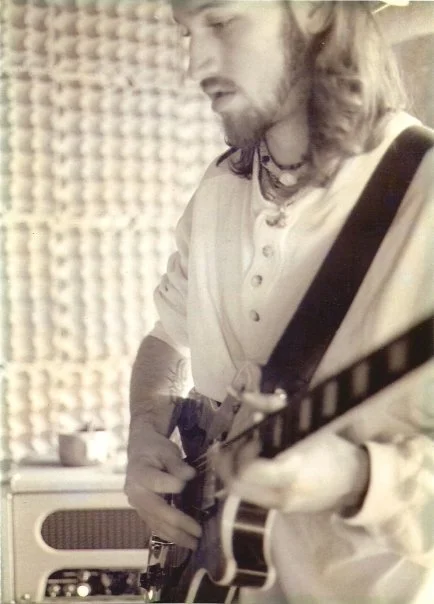
In the backyard shed on Shotwell St. (1998)
The five of us—Ricky and me on guitars, Nathan on keys, Hunter on bass, and Tony on drums—landed our first gig at Newby’s on Highland St. in Memphis, opening for local jam-rock powerhouse FreeWorld for their Dec. 26, 1998, Christmas extravaganza. The other opening act, who played right after us, was none other than the great North Mississippi Allstars. It was one of their first gigs ever, too.
We needed a name. The name we settled on was Jones, inspired by our good friend and one of our earliest fans, Andy Jones, noting also the alternative meaning. We had a “jones” for a lot of things, but mainly to get out and play.
Shortly after that first gig, Ricky bowed out (which made sense—he was preparing to go to medical school), and after auditioning a couple others, we finally settled on the lineup that would last for the next two years: Hunter and me on guitars and trading off lead singing duties, Nathan on keys, Tony on percussion, and two new members: Luke Kende on drums and Steve “Stevie LA” Auttonberry on bass. Once this lineup coalesced, it was like we shot out of a cannon.
We had a van and started playing road gigs. We played as far away as Evansville, IN, and Athens, GA, but mostly stayed in and around Memphis. There was much bonding going on during spring and summer of 1999, and things were moving fast. Lots of things. Some maybe too fast. But we were excited, and people were excited about us.
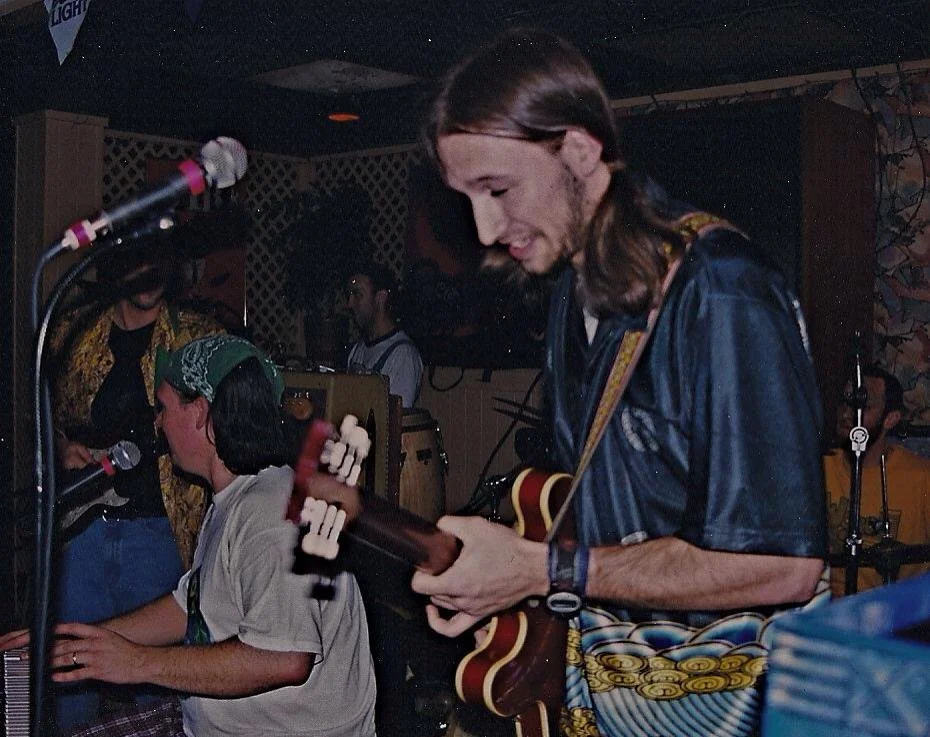
Jones at Midway Café in Memphis (Feb. 1999)
In late 1999 we started production on a full-length album of all original music. Recording began at historic Easley-McCain Studio in Memphis. The album was funded by a young local entrepreneur and music enthusiast, Christian Magee. We got FreeWorld co-founder and Memphis music icon, Richard Cushing, to be the album’s producer. It was a thrilling experience.
However, we ran into a snag. We discovered that there was a band operating in Nashville called The Jones, and they had copyrighted the name and threatened to sue us if we released an album under the name Jones. We went to see them perform once. They were a cheesy 80’s cover band. Super lame. We were offended at the idea of having to change our name because of those clowns. Nonetheless, faced with this legal conundrum, we expanded our official name to The Memphis Jones Revolution—a mouthful, but we still went by just Jones among ourselves and our small but devoted fanbase.
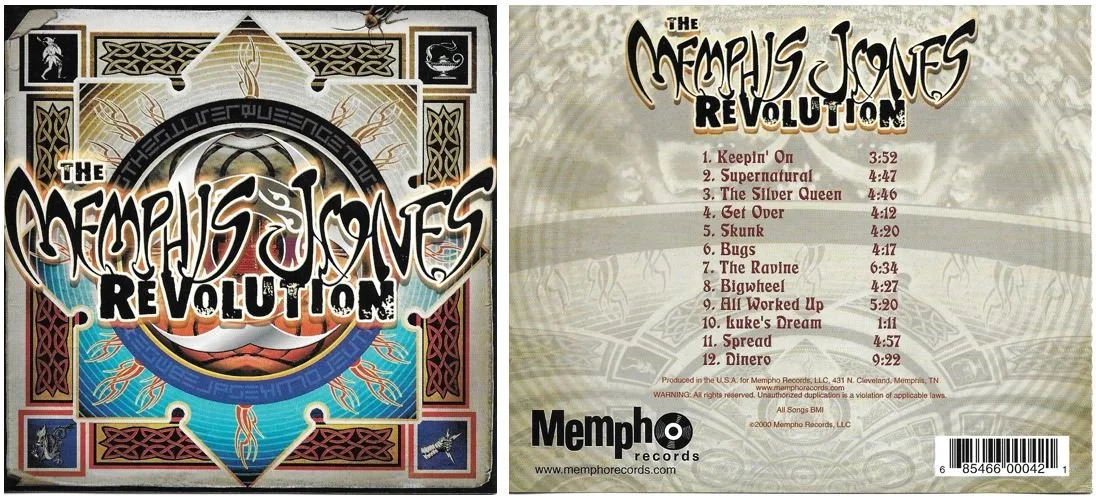
MJR album art, outside cover (Artist: Barry Erby)
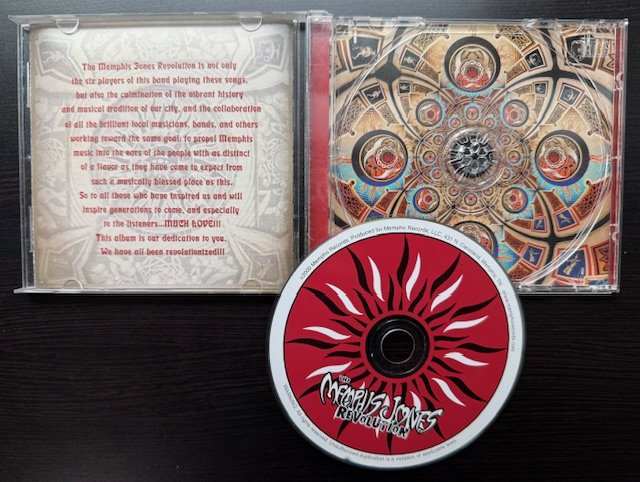
MJR album art, inside cover & disk (Artist: Barry Erby)
The MJR album is, if I do say so myself, pretty incredible and has stood the test of time (over 25 years later, I still love it). After carefully recording all the tracks, partly in the studio and partly at Christian’s house, he paid for us to go all the way to NYC to have it mastered at MasterDisk Studio. Walking through the hallways of that studio, we noticed that many of the albums displayed on the walls that had been mastered there were gold and platinum, by some very well-known artists. It was hallowed ground to us. We thought, “We have arrived.”
I wrote or co-wrote all but three songs on the MJR album and played about 75% of the guitar tracks (although, I must say that the guitar parts Hunter added were truly exquisite). I also sang lead on about half the songs. Hunter was the one with the golden voice who sang the other half. Steve (a truly phenomenal bassist) wrote two others and co-wrote the opening track with me and Hunter, and one track was an instrumental djembe and didgeridoo vibe-out by Luke. You can listen to my four favorite tracks below:
Supernatural was written by me, but Hunter sang the lead vocals. It’s basically an ode to my love of music. If there had been a “hit single” on this album, this was it.
The Silver Queen (co-written with N. Willingham and H. Rozen) was the name of a roadside motel in Kingman, AZ, where we were stranded for a couple days on a road trip out to California. This track stands out for multiple reasons. First, Hunter’s superstar-worthy vocals (he sings verses 1-2 and then 5-6). Second, I may get old, but my guitar solo on this track never will. Third, the guest keys played by the legendary Ross Rice (that’s also Ross playing the Hammond B-3 organ on “Supernatural”)—he was a legit local music hero around Memphis during that time. Fourth, the backing vocals provided by well-known local singers Reba Russell, Raine Hicks, and the incomparable Jackie Johnson. This track has it all.
Skunk is a funk instrumental that I wrote and that the band perfected. It’s exactly 4 minutes and 20 seconds long, which was intentional (draw your own conclusions, dude). This may be my favorite track on the whole album. We got our good friend, the magnificent Lee Sharp, to add the saxophone part. The interplay between my lead guitar and Lee’s sax at the end is probably my favorite thing I have ever recorded. It gives me chills to this day.
All Worked Up is an anthem about playing in a band and everything that goes with it.
If you’d like to download the full MJR album, click on the following link: [MEMPHIS JONES REVOLUTION]. It’s not available on any streaming platforms. You can’t hear it on the radio. You can’t hear it anywhere you go.
In spring of 2000, MJR was nominated for “Best Newcomer” at the annual local music awards ceremony hosted by the Memphis Chapter of the Recording Academy (the national organization that hosts the Grammy Awards). We didn’t win, but we definitely showed up at that event like bonafide rock stars and then painted the town red until the wee hours of the morning.
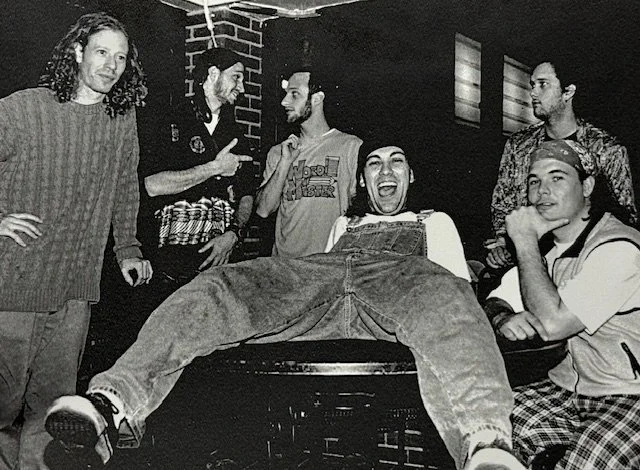
Jones. From left to right: Stevie LA, me, Luke, Tony, Nate (front), Hunter (rear). (Feb. 1999)
Alas, it’s hard enough to catch lightning in a bottle, much less hold onto it. By summer of 2000, before we could even tour and promote the album properly, Luke had decided to quit the band for personal reasons. That was the beginning of the end (not that we could fault Luke in any way for his decision). We replaced him with one of the most sought-after local drummers in Memphis, Victor Williams. We played several local shows with Victor, but it wasn’t long before egos and… let’s just say bad decisions (both individually and collectively)… got in the way, and the band exploded. MJR was gone before it ever really had a chance to take off. I was devastated.
Shortly thereafter, in fall of 2000, I left Memphis for an extended, 14-month excursion out to Colorado where I would regroup, continue to write songs, and think about my next move… and go to some WSMFP shows at Red Rocks (if you know, you know). Just long enough to go summon the Holy Ghost from the battlefield…
Chapter 5. The STOUT Train Cometh (2002-2004)
Today I am invincible At least that’s what I’m telling myself Still, so many questions linger in my head Tomorrow wishes to greet the sun But will the sun decide to show itself? Gray skies within My mind, but then You walk in
Today felt shorter than yesterday Tomorrow will feel shorter still Time slips through my fingers—it chips away at me I’m spending seconds but saving none At least I’ll know when my time is done Time flies within My mind, but then You walk in
I returned to Memphis in late 2001, ready to hit the ground running and get a new band together. The first person I called was my old friend, the musical Swiss Army knife, Graham Burks. Graham mainly played drums back then and said he knew a bass player, Jeremy (whose last name I don’t remember). This Jeremy cat was a little weird, but he was looking to jam with someone, so the three of us started getting together.
One night, out at a bar / music hall on Beale St., Jeremy said he knew a piano player that we should talk to, who happened to be there that night. This piano player introduced himself to me as “Junior.” [Digression: There’s a funny story about my first ever meeting with Junior, but it’s not a P.G. story so I won’t relay it here. Let’s just say he had a major foot-in-mouth moment that made him feel like he had no choice but to accept my invitation.] So, this Junior fella, whose real name is Craig Schuster (and who is not a real Jr., incidentally), agreed to come jam with my band if I would agree to come play guitar for his band. Their guitarist had recently quit, and they were thinking about disbanding altogether, but they wanted to play one final show and needed a guitarist to fill in. We had a deal.
So, Graham, Jeremy, Craig (a.k.a. Junior), and I started getting together to try to get something going, but it wasn’t really working. Meanwhile, I went and rehearsed with Craig’s band, called Speakeazy for the fact that the basement they rehearsed in had been a real speakeasy during the prohibition era. In addition to Craig (and myself), this band consisted of Rory Gardner on bass and Robert Kamm on drums. Things clicked pretty much immediately. Little did I know at the time that these guys would become my lifelong friends.
During the second or third rehearsal, after finishing a song, we all kind of looked at each other like, “holy $@%!” Maybe they shouldn’t break up after all. Maybe we should see where this thing goes. And that was all it took. We were already plotting world domination.
Our first show together, which was originally supposed to be their last show together, was on 2/22/2002, which we still celebrate amongst ourselves every year as “Stout Day,” even though the band was still called Speakeazy at that point. We played about 11 songs, mostly originals that Craig had written before I had joined, but also three of mine that I wrote while in Colorado, and a couple covers.
After playing a few more local gigs together, the train was building momentum. I convinced them to invite my old friend and partner in crime, Tony Walsh, to come play percussion. Tony, with his arsenal of percussion toys (many of which he kept in a gray road case that became known as the Yahoo Box) was the missing piece of the puzzle. We were now complete.
Later that summer, we heard about this band Speakeasy from Springfield, MO, who had landed a gig in Memphis at one of the main local venues. We were indignant. How dare these chumps think that they can come onto our turf with our name? So, we went to hear them play, ready to defend our honor and our name. Umm… they were incredible! We immediately befriended them and agreed that we should change our name, since they had been playing as Speakeasy for much longer. They became our pals, and we all played many gigs together over the next couple years, both in Memphis and in Springfield, and in a few other places.
After much deliberation, we landed on the name STOUT (we drank a lot, so it worked). Our first gig as STOUT was opening for Memphis legends, The Gamble Brothers Band, on Aug. 14, 2002 at The Hi-Tone. If you don’t know the Gamble Brothers, Al Gamble went on to be the keyboardist for Alabama soul-rockers, St. Paul & the Broken Bones, and Chad Gamble is the long-time drummer for none other than Jason Isbell & the 400 Unit. Like I said, legends.
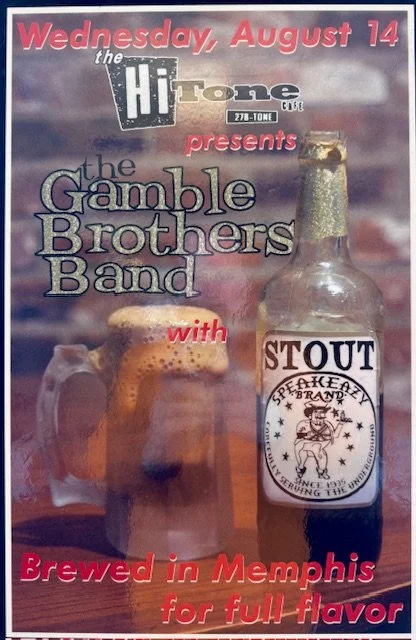
Flyer for the first ever show as STOUT, opening for the Gamble Brothers Band at The Hi-Tone, Memphis, Aug. 14, 2002. Designed by Graham Burks.
From that point forward, STOUT felt unstoppable. We were playing gigs relentlessly, booking shows all over the Southeast. We were writing new music at a torrid pace—mostly Craig and I writing songs individually and then bringing them to the band. Occasionally he and I would collaborate on writing a song together. Later on, Robert got in on the action by writing lyrics that he would hand off to either Craig or me to write the music. We felt like the Beatles. It was awesome. By the time it was all said and done, we had a repertoire of 50 original songs and probably 20-25 solid covers.
A digression on songwriting: When I say that I “wrote” such-and-such song, or Craig “wrote” some song, what I mean is the following. The person who “wrote” the song wrote the lyrics, the part for their own instrument, and the basic structure (i.e., main riff, verse, chorus, bridge, etc.). From there, the song was presented to the band, at which point it became a collaborative and iterative process where we worked through the arrangement piece by piece as a group. Each person pretty much figured out their own parts (if there was one thing Robert hated above all else, it was when I tried to tell him what to play on the drums). We typically left lots of room for improvisation, and maybe the structure would be tweaked a bit if something different was found to work better. The point is, by the time the finished product emerged, it was really a full-band creation. We would then practice it over and over again until we had it memorized, but even then, it would continue to mutate and grow as we got more and more comfortable with it. It was an organic, evolutionary process. That kept it from ever getting stale. There are musicians who can perform the exact same part or solo flawlessly every time—no improvisation, just recital. That’s one way to do it, but that wasn’t us. We were very fluid, typically flying by the proverbial seats of our pants. It meant we made some mistakes when performing, but it also gave us unrestricted freedom to explore and push boundaries. Okay, digression over.
By late 2002, we started thinking about recording an album of our originals, which we soon did. It was funded by another local entrepreneur and music enthusiast, JDe DeHart (who also went to my high school but graduated a couple years before me). Recording happened at a studio called Young Avenue Sound. The album, which was eventually released in April of 2003, was titled On the Rocks (like I said, we drank a lot… for better or worse, it was part of our identity as a band). About half the songs were written by Craig, and half were written by me, and there’s one that we co-wrote together.
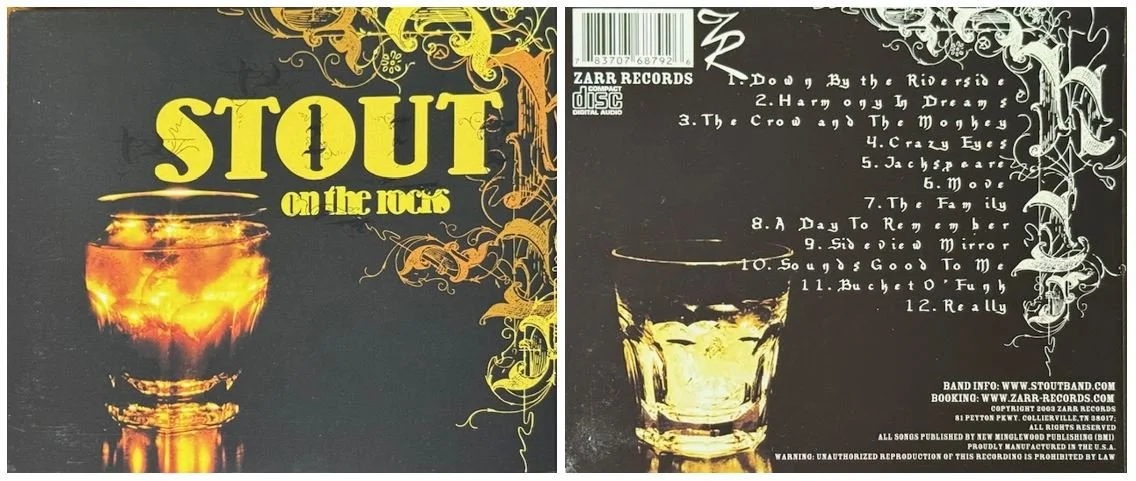
OTR outside cover. (Artist: Andy Vastagh, but if memory serves, the photos of the whiskey glass were taken by Graham Burks)
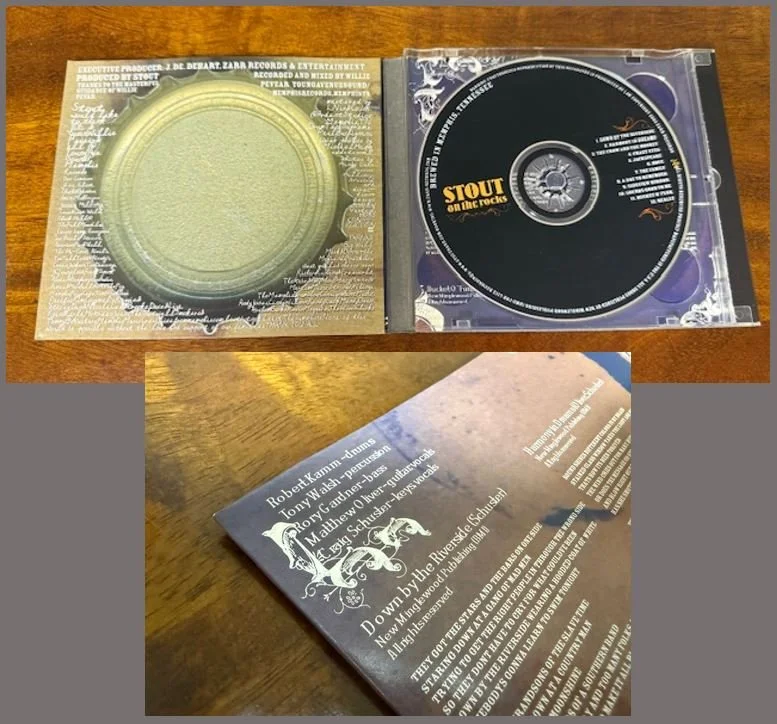
OTR inside cover. (Artist: Andy Vastagh)
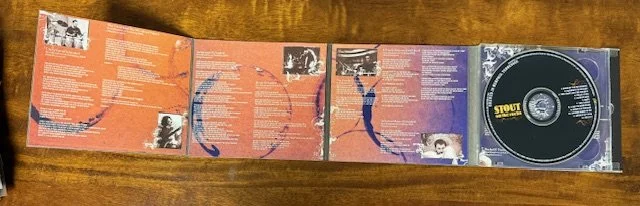
OTR full inside cover.
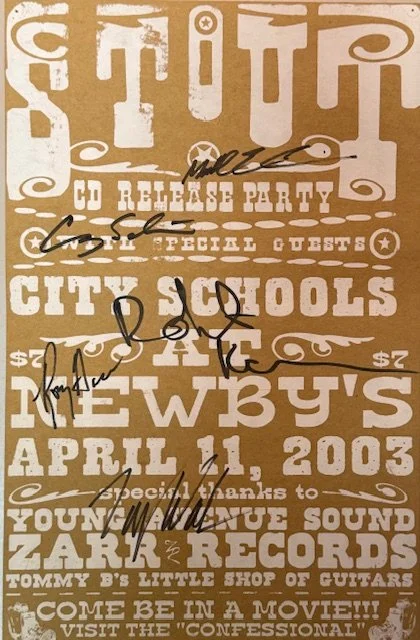
Signed OTR CD release party flyer. (Artist: Andy Vastagh)
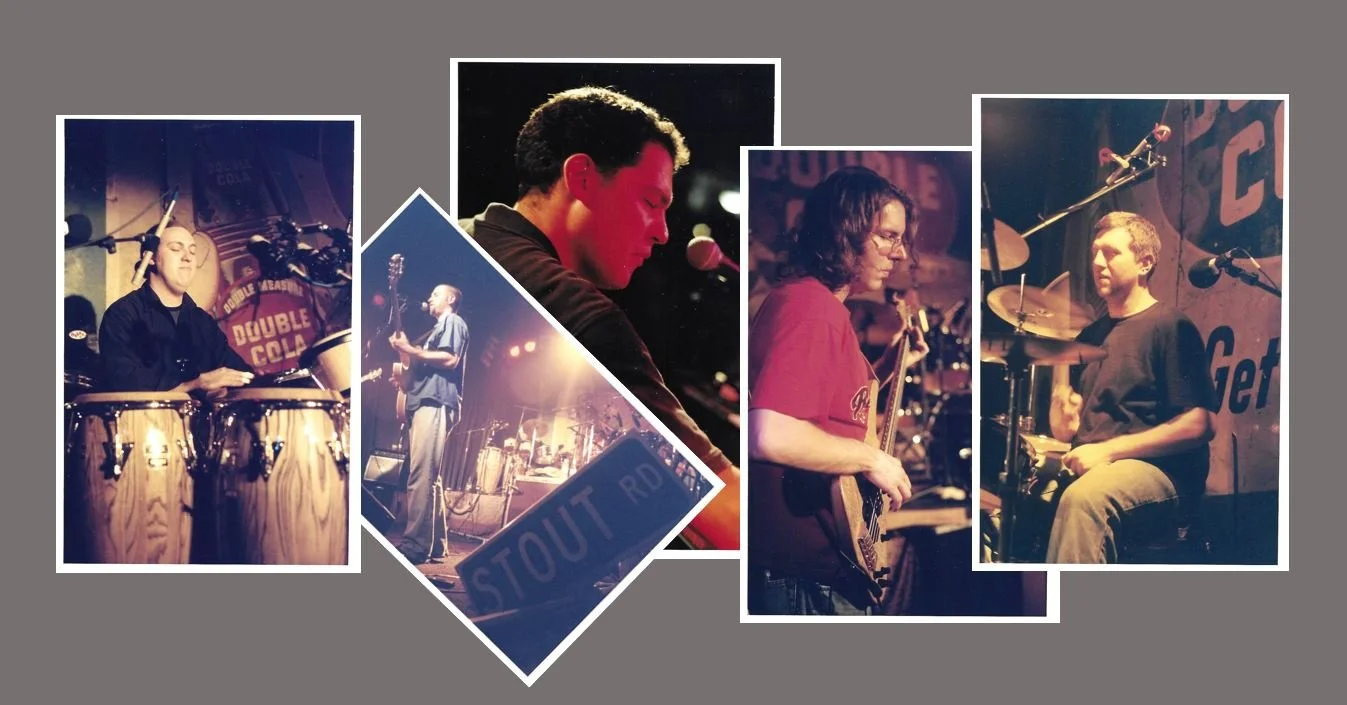
Left to right: Tony, me, Craig, Rory, Robert. STOUT On the Rocks CD release party. April 11, 2003. Newby’s, Memphis, TN. (Photos by Ross Smith)
In hindsight, the rest of the guys sound great, but I was never really happy with my own performance on the OTR album. It’s good, but it could have been so much better. I don’t like my guitar tone or my vocals. I just wasn’t as locked in as I should have been. I didn’t insist on perfection as much as I should have, partly because the studio was expensive, and we didn’t have unlimited time or money. Oh well, perfection has never been what drives me, then or now. I can still appreciate OTR despite my lingering disappointment in my own effort. The songs hold up. We could write a tune with the best of them.
Here are a few samples, two written by Craig and two by me, which you can listen to below.
Down by the Riverside (Schuster) - The quintessential Craig STOUT song. It’s about an infamous night at the old Memphis in May Music Festival, where a certain juxtaposition of acts on different stages could have ended badly if their respective crowds had chosen not to mix with each other courteously.
The Crow and the Monkey (Oliver) - The quintessential Matt STOUT song. This was my attempt to write a song that sounded like the Black Crowes. Slide guitar in open-G tuning. As for the lyrics, what’s this twisted Aesop’s fable about? You’ll have to figure that out for yourself.
Jackspeare (Schuster) - This is my personal favorite track on the album. It turned out great. Tony absolutely shredded those congas, man. I forget the full backstory, but it’s a musical portrait of a real person. Quoth the backwoods philosopher: “The older I get, the more I realize, not how smart I am, but how stupid I have been.”
Really (Oliver) - Girl, I was writing breakup ballads back when Taylor Swift was just a kid. This was the closing track on the album. It ends with a beautiful solo by Craig on the baby grand.
If you’d like to download the full On the Rocks album, click on the following link: [STOUT - ON THE ROCKS].
At the end of the day, STOUT was a live band. We ended up playing over 350 shows in under three years. 220 of those were on the road, booking gigs in over 60 cities. We logged thousands of miles, traveling as far east as Hilton Head, SC, as far south as New Orleans, as far north as Cleveland, OH, and as far west as Utah. For the first year, we packed up Craig’s little white Toyota pickup and Rory’s Camry and led our heady caravan to wherever we needed to go (Huntsville and Little Rock were regular early stops). Then, for the second year or so, our tour vehicle was an old RV we affectionately named “Lucky” (because of how often it broke down on the side of the highway), behind which we towed a trailer with all our equipment. The trailer had a big Juicee Gummee logo on it (a now defunct candy brand). Robert had cut a deal with them through his girlfriend (I forget her connection to the company) to give us a small sponsorship, in exchange for displaying their logo on our trailer and handing out free gummy bears and gummy worms at our shows—very entrepreneurial.
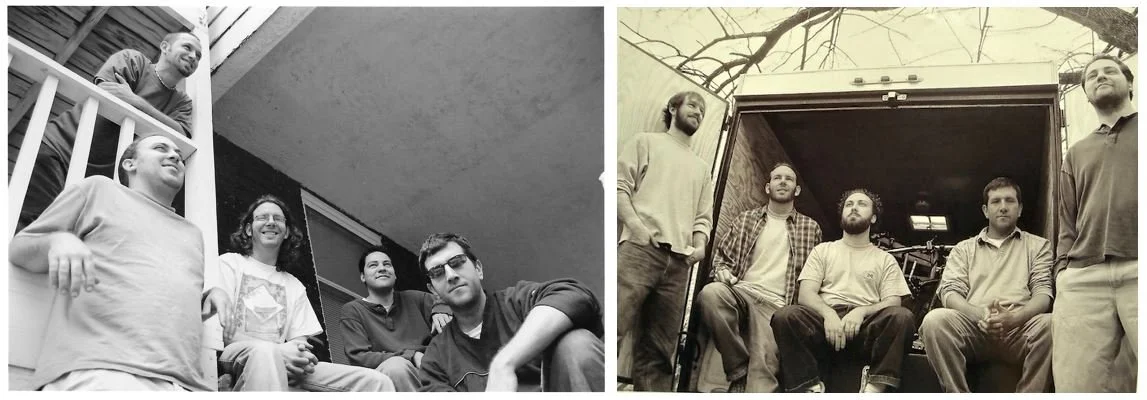
Left: Promotional photo taken in 2003, somewhere in Nashville if I remember correctly (Photo credit: Ross Smith). Right: In front of the trailer sometime in 2004 (Photo credit unknown. Probably also Ross Smith, but not sure. Claim it if you took it.)
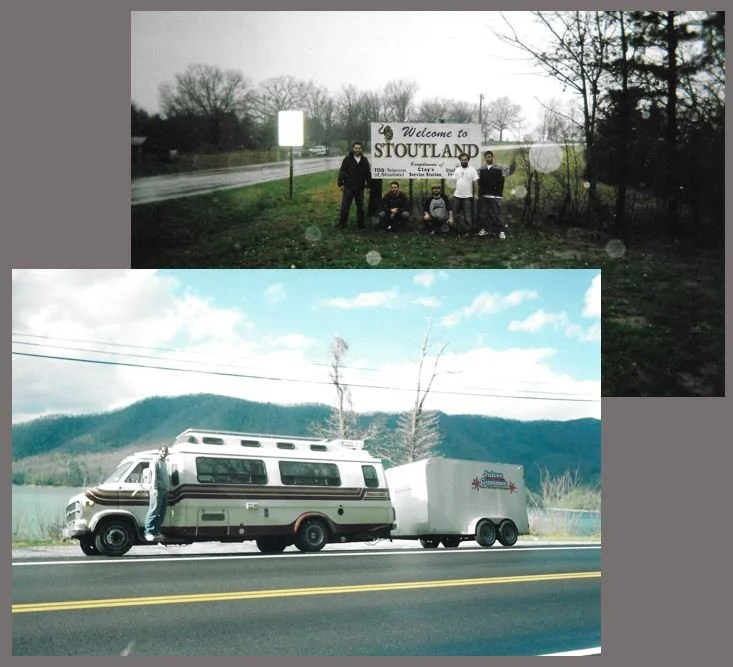
Bottom left: Me & Lucky, somewhere between Boone and Asheville, NC (November 2003). The greatest Lucky story of all time occurred about a month after this photo was taken. Lucky went dead just outside of Springfield, MO, at around 3am, on our way back to Memphis after a show with our friends Speakeasy. It was about 15 degrees outside. After freezing our balls off waiting for two different tow trucks and a taxi to take us and Lucky back to Springfield, it was about 8am when we finally got to the mechanic’s shop. Lucky was dead, and we had an important gig in Memphis at the New Daisy theater that night. A good samaritan overheard our plight and (as God is my witness, I swear I am not making this up) let us take his church’s van back to Memphis. He trusted us to bring it back in one piece. So, next thing we knew, we were a band of stanky swampfunked misfits hauling our Juicee Gummee trailer full of rock ‘n’ roll gear back to Memphis in a fully consecrated, honest-to-god church van. What can I say? We kept the Lord on our side, we took the Devil in stride. We made it back to Memphis just in time for our gig. Craig and I took the church van back to Missouri a couple days later. Never even saw the guy when we dropped it off. No one was there. We just left it out front with the keys in it and headed to Columbia (where Craig’s parents lived). 100% true story. Top right: Driving through Stoutland, MO (March 2004).
STOUT could straight light it up when we got on the stage. The other guys might give you a different answer, but if you asked me, I’d say our overall vibe was based on two key ingredients: (1) a good balance of structure and improvisation, and (2) a wide variety of song styles, while maintaining a common thread throughout everything we wrote. That’s the kind of music we each enjoyed, so it was natural for us to follow that model. Writing songs in as many different styles as possible became almost a challenge for Craig and me. We touched on country, blues, jazz, funk, reggae, New Orleans R&B, classic Southern rock, prog, heavy metal… you name it. We also changed our setlist up for every show, just like our favorite bands do. To keep things egalitarian, we had a rotation system: each of us got to pick the set list every fifth show. I guess you just have to wait your turn. We were shooting from the hip and letting it rip, but no matter what we did, it friggin’ rocked.
The greatest documented evidence of our live act is from a show we played at a venue called The Casbah in Johnson City, TN, on March 4, 2004. The crowd on a cold Thursday night in March? Pretty sparse. But that didn’t really matter. There was a local cable-access television show called Homemade Jam that featured live bands when they came through town. They wanted to have us on their show, so they brought out pro-level cameras and put together an amazing video compilation of some of the songs we played that night, all with a fantastic audio mix. These videos are now available on YouTube, and I have linked them below. They truly captured what it felt and sounded like to us when we were playing. Hats off to the Homemade Jam production crew, wherever they are now. These are truly a treasure to us. They, more than anything else that has survived, will give you the truest glimpse into what STOUT was capable of. Also, I would be remiss not to salute Robert and Rory for their excellent interview chops, which are also featured in the show!
STOUT: Rory Gardner (bass), Robert Kamm (drums), Matt Oliver (guitar & vocals), Craig Schuster (keyboards & vocals), Tony Walsh (percussion & backing vocals)
Homemade Jam – Part 1. [Watch YouTube video] Songs featured:
Noah (Oliver) – This is a song about… honestly, I don’t know what it’s about. The lyrics are pretty abstract. Enigmatic, even. They’re about whatever you want them to be about, man.
Wait Your Turn (Oliver, Schuster) – Kind of similar in abstraction, but maybe slightly less abstract. The lyrics here paint a kind of hazy picture of our general vibes around this time, trying to get the band off the ground. Ain’t no use in baitin’ the hook when you’re fishin’ in the drainage ditch.
Homemade Jam – Part 2. [Watch YouTube video] Songs featured:
Pullin' My Weight (Oliver) – This song was about my commitment to this band. I was all in, living for the moment, and ready to pull my weight.
Lakehouse Lounge (Kamm, Schuster) – Lyrics by Robert, music by Craig. Easily one of the most complex arrangements in our catalog. The Lakehouse Lounge was the nickname of the DeHarts’ vacation home out at Pickwick Lake.
Homemade Jam – Part 3. [Watch YouTube video] Songs featured:
Jalapeño Cornbread (Schuster) – One of Craig’s tunes. Just a fun one to shake your butt to. Is it literally about jalapeño cornbread? Why, yes. I believe it is. What yo mama said.
Ain't It a Bitch (Kamm, Schuster) – Lyrics by Robert, music by Craig. Such a killer tune. One of my favorites. This song features the slide guitar in open-E tuning, Duane Allman style. A song about chafe and strife.
Homemade Jam – Part 4. [Watch YouTube video] Songs featured:
Down By the Riverside (Schuster) – Craig’s all-time classic, explained earlier.
Against My Will (Schuster) – This is another classic Craig song about the swampfunk, to which he had a strong aversion, but to which he was frequently subjected via second-hand exposure. Flim-flammed, as usual.
Testament (Kamm, Schuster) – Robert’s crossroads-esque lyrics, only this time, Legba was a no-show. There’s no trade for a bitter man’s soul.
STOUT live was like taking a shot of whiskey and getting punched in the face (or catching a china cymbal to the cranium)… and coming back for more. Wipe off the blood and get back in the ring. We were rarely perfect, but what we lacked in precision we made up for with an onslaught of fearless rock ‘n’ roll energy. Our drinks may have been ice cold, but we were a hot mess. It was great.
Although the sound quality isn’t quite as good (but still pretty darn good with good headphones or speakers… just more raw), I’ve selected a few more live cuts of our original songs, along with a classic cover:
I’ve Got a Feeling (Beatles cover) - One of our top two or three covers, and a STOUT show staple. Everybody had good year. Everybody let their hair down.
Still Hangin’ On (Schuster) - A love song Craig wrote about one of his old keyboards.
The Piece (Oliver) - So named because it was this long, really complicated “piece” of music, and we simply couldn’t think of anything better to call it. I was definitely emulating Phish here, but it’s maybe more in the vein of 70’s prog-rock visionaries, Yes. My favorite thing about this recording is the dog barking off in the distance during the quiet part. Probably one of the first few times we had played it in front of a live audience.
Cerebral Spin Cycle (Oliver) - A headbanger about how the ol’ boob tube will rot your brain, man. Junior innovated what he referred to as “heavy metal piano” for this one. It’s a great recording of this tune, and I love how at the end of us totally crushing it, there’s like four tired, drunk people who gave a little half-ass cheer. And the crowd goes mild. LOL. Thanks for hangin’ in there, guys, whoever you are. I gotta go.
Bucket O’ Funk (Schuster) - An instrumental that Craig, Rory, and Robert had been playing since long before Tony and I came along. More heavy than funky, and every time we played it, we inserted a tease of something. We had a few good ones over the years: the “Whole Lotta Love” jam (Led Zeppelin), the “Gypsy Queen” jam (Santana), “Miserlou” (Dick Dale) with Craig busting out the trumpet, and probably a couple others I’m not remembering. Basically anything that was in the key of E and rocked would have worked. But the one we did most often was “Rock Your Socks” by Tenacious D. The classical sauce. Give ‘em a taste, Junior.
Stout Train (DeHart, Oliver) - Lyrics partially supplied by JDe, and I put them to music. A satirical heavy metal song about STOUT kicking ass. Style: Black Sabbath, Spinal Tap, Tenacious D.
Oversized Load (Oliver) - Some of my favorite lyrics that I’ve ever written. Almost every line alludes to some underlying story of STOUT’s wacky adventures. Style: Late night shut-the-bar-down sing-along drinking song. The idea was to get everybody to raise their drink and sing along with Craig’s harmonica melody. Later on in this song’s evolution, Robert would get up from the drumkit and go to the bar to get a drink while Tony took over on drums.
If you’d like to download a longer compilation of live STOUT (including the above recordings), click here: [LIVE STOUT COMPILATION]. But even this really only scratches the surface of what’s available. As I mentioned above, we had 50 original songs and a bunch of great covers. (Also, I have to give a big shout out and thanks to “Taper Tim” Discenza for coming out to so many of our shows and bringing his equipment, to whom we owe credit for a huge catalog of live STOUT recordings. Thanks, Tim!)
STOUT had some great moments, including several brushes with greatness. We opened for 80’s alternative darlings, Violent Femmes, at the incredible Mud Island Amphitheater (the same venue where I saw Phish for the first time, and so many other great bands… reopen it, Memphis!). We played SXSW 2004 in Austin and partied with the dudes from Blues Traveler. We jammed with an original member of the legendary Motown Records studio band, The Funk Brothers. Eli Manning made an appearance at one of our shows in Oxford, MS. We drove a lot of miles, made a lot of great friends along the way, shut down a lot of bars, and there are simply too many stories to recount them all here.
Unfortunately, in late 2004, egos and bad decisions (exacerbated by pure exhaustion) wrecked that band as well. Yet the best thing about the whole experience was this: After a while we came back together and became friends again. In fact, those guys are still some of my closest friends, over 20 years later. They’re like brothers to me. They’ve probably been talking sh*t the entire time they’ve been reading this.
We did three reunion shows, in 2009, 2010, and a final one in 2011. I have since retired from music fully, which I will explain below. But first, there’s one more flash-in-the-pan project worth mentioning.
Chapter 6. Toccata (2009)
The captain, he is leaving Oh, that ship—that ship is sailing I hope that maybe someday he’ll come back for me When I’m ready How will I know when I’m ready? Will he still care when I’m ready? Maybe I should just go now No, I think I’ll stay I mean, I guess I’ll stay Another ship will come my way
In 2008-09 I was a first-year economics PhD student at the University of Wyoming. Among the many great people I met in that first year, there were three individuals who really made me feel right at home. The first was the incomparable (and indefatigable) Jamie Pike, who would eventually agree to marry me. So, I’ve got that going for me, which is nice. The second was that great and wise sage of the mountain, Jay Shogren, who had by then accomplished just about all there was to accomplish in economics and was rekindling his own musical ambitions, moonlighting as a troubadour around Wyoming. Jay and I bonded over music before he ever taught me any economics. The third was the perpetually needling but good-hearted Chris Kennedy, who became my best grad school pal. We went skiing/snowboarding together, traded old Phish tour stories, and even caught a Phish show together in 2010. I should also mention that one of my oldest friends, Kris Buranapiyawong, and his wife Katherine had established themselves in Denver by then, so I spent a lot of time down there with them. Kris and I shredded Copper Mtn together frequently. I am forever grateful for their hospitality during those years. It meant a lot to me.
In spring of 2009, I got together with a group of guys in Laramie for a one-time-only gig. This band consisted of myself on guitar and vocals, a local guy Andrew Galbreath on bass and backing vocals, my fellow economics PhD student Brian Enchelmeyer on keys, and local multi-instrumentalist John Kirlin on drums. But what made this band unique was that Andrew had the idea of inviting his younger brother, Dan Galbreath, a classically trained violist (the viola is a slightly larger cousin of the violin), to come play with us as well. I said, sure. Dan had never really played that kind of music before, but to his credit, he was very talented and managed to hold his own quite well.
We called the band Toccata, a shortening of J.S. Bach’s Toccata and Fugue in D minor, which Brian knew on the keyboard by heart, so we worked it into our live set as a very dramatic opener—a rock-block of Bach. It was fun. We put together a short set of originals and covers and played our one show at a local bar with a band called Mumbletypeg, whose drummer was one of our economics professors, Ed Barbier.
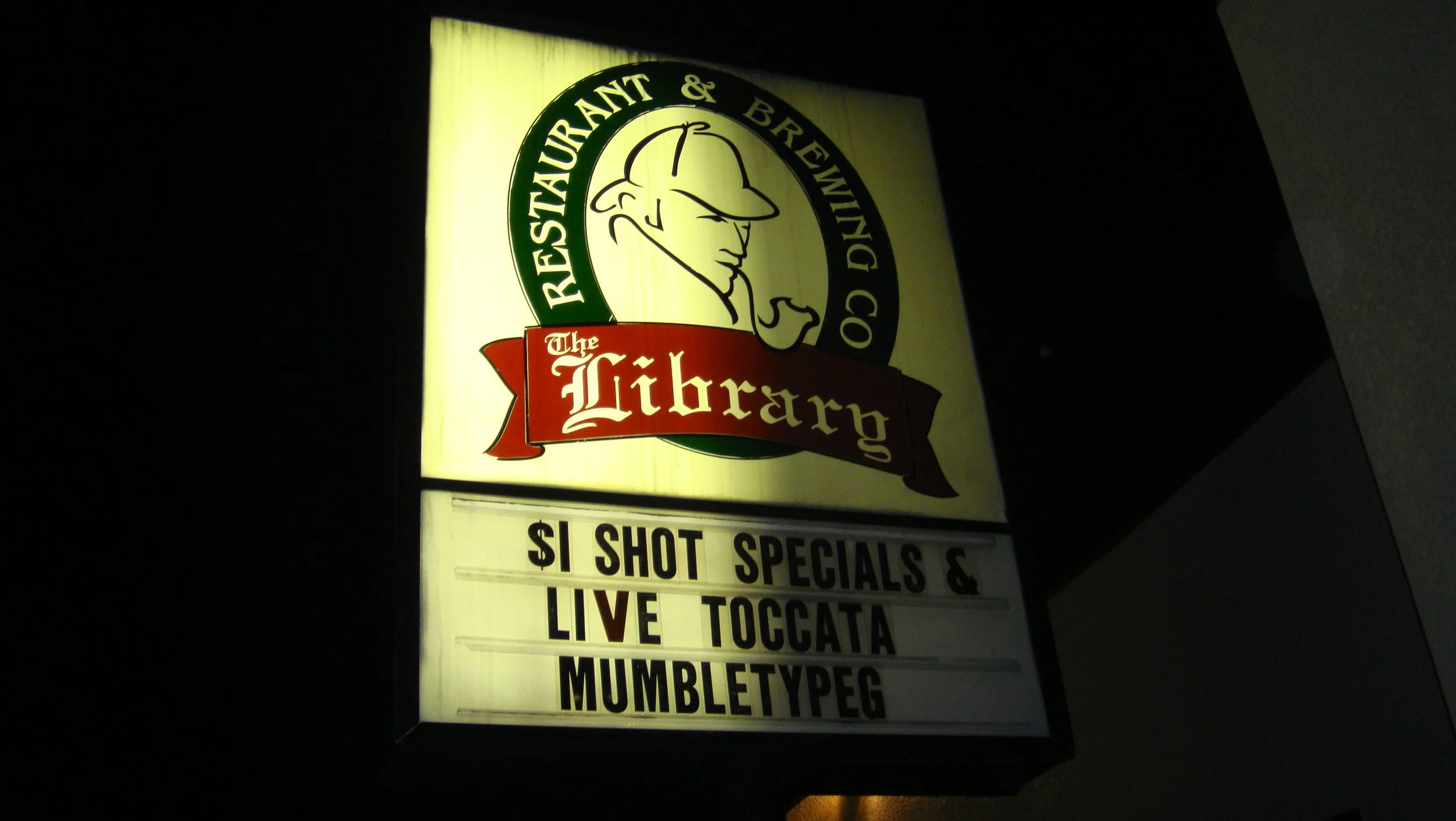
Laramie, WY, May 2009.
The gig went off pretty well. However, to properly document the band for posterity, shortly afterward I booked us a couple days in a local studio in Laramie, Thunderground Sound (with Dan Tinker at the controls), where we recorded the originals. You can listen to a few of them below. Three were old STOUT songs that we retooled for Toccata. The other two were new songs that I had written for Toccata. They were the last two songs I ever wrote.
When I Get Back Into Town - One of the old songs I had written when I lived in Colorado, way back in ‘01, that then became a STOUT standard (we used to call it WIGBIT).
Stranded - An old STOUT song about not missing your proverbial ship when it comes in. You might regret it. Absolutely love the sorrowful viola on this track. Remember that old Tom Hanks movie, Castaway, where he’s stranded on a deserted island and paints a face on a volleyball to be his companion, Wilson? Okay, so replace the volleyball with Mr. Coconut, and you’ve got the lyrics to this tune. It’s also got the Grand Funk Railroad “Closer to Home (I’m Your Captain)” style interlude in the middle.
A Song You Know - Another old STOUT song that switches back and forth between waltz and reggae, ending on a punk rock outro. What can I say? It worked.
Circles - Some things never change. Sometimes it feels like we’re just running around in circles. A rocker.
Medicine Bow - A lovely instrumental featuring John Kirlin on mandolin and named for the mountain range overlooking the Laramie valley.
Not bad for a couple days’ work.
Chapter 7. Retirement (2011-present)
Never thought I’d run away from a failure I guess I never really expect to fail As each new day unfolds, I really can’t remember Ever getting so much mail But I know, it’s all bills
When STOUT broke up in 2004, I was at a crossroads—either keep riding this music dragon until I tamed it or it killed me, or leave it behind and go in a totally different direction. I chose the latter. At 28, the starving artist lifestyle was starting to take its toll. I didn’t have it in me to start over with another new band. I craved stability. I re-enrolled at University of Memphis, completed my bachelor’s in 2008, and shipped off to Wyoming. By 2013 I had gotten married, completed my PhD, and landed my professor job.
After STOUT’s 2011 reunion show, I officially retired from playing music. A lot of people seem disappointed by this when I tell them, and I get it, but I have my reasons.
The first is physical. In summer of 2012, I was playing rec-league softball in Laramie and broke my left wrist really badly, trying to be Willie Mays on a pop fly over my head (I did not make the catch). I had surgery and everything; they put a titanium plate in there. Pretty gnarly. Since then, I simply haven’t had the hand strength needed to play the guitar. And, what’s more, I haven’t had the desire to put in the work it would take to get it back.
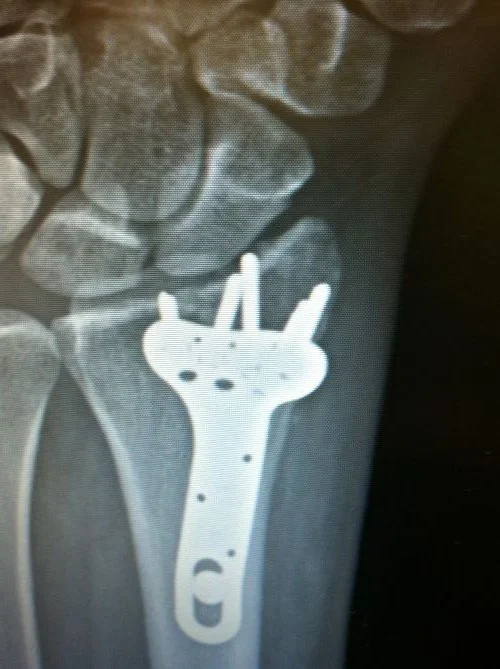
A very expensive piece of equipment. The university’s student insurance plan screwed me over a paperwork error and stuck me with the bill for this sucker. Took me years to finally pay it off. Gotta love that for-profit healthcare system. Hooray, capitalism. (Summer 2012)
The second is that I had successfully built an entirely new life for myself, and the demands of a new family and new job in an up-and-coming economics department at one of the finest technical universities in the country effectively superseded any other priorities I might have had regarding continuing my music career. As we would say in economics, the opportunity cost of my time had increased significantly.
Will I ever play music again? I’m not ruling it out. But I’m also not promising anything. Maybe I will, maybe I won’t. It’s not something you can force, either way. You can’t manufacture inspirado.
And you may find yourself in a beautiful house, with a beautiful wife And you may ask yourself, "Well, how did I get here?"
Well, that’s how I got here. Now you know the full story. If you read this whole thing, thanks. I hope you enjoyed it. If not… meh. Same as it ever was. Same as it ever was.
Acknowledgments
Lots of times, when I’m driftin’ down And I’m floating away on a pillow of sound It’s easy to hear that everyone cares And we’re all just like a bunch of big gummy bears Dancin’ around on Judas’s plate Only because it would irritate The thorn of betrayal that sticks in his side And reminds him of that which he’s tryin’ to hide But that was really deep, and I’m almost done And singin’ this song has been really fun It’s easy to act like you care when you don’t But vice versa is torture, and that’s why I won’t Bottle myself until I explode I’ll get by with a little help with my oversized load
There are far too many people who were directly involved in and/or sufficiently close to the action at some point in this history for me to mention them all. However, a few deserve acknowledgement who were not already mentioned: Tim & Diana Oliver (my parents), Randy Beck, Brandon Edwards, Cassie Jackson, Larry (the band, Austin, TX), Dan & Nicola Tupis, and Brian “Floyd T. Moneybags” Walsh. If anyone feels slighted that I left you out, I’m sorry.
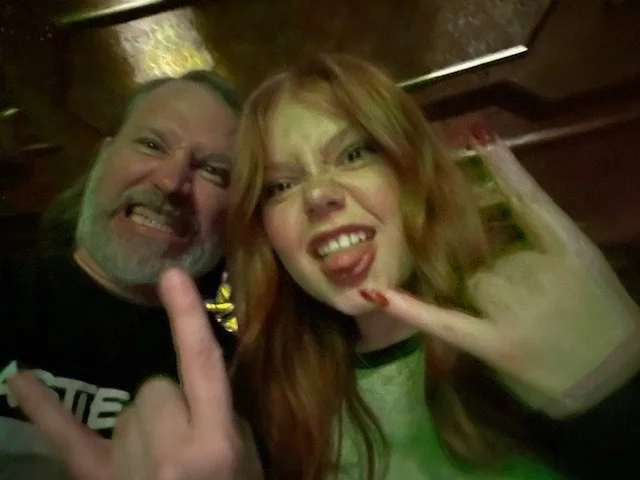
They say the apple doesn’t fall far from the tree. Maybe so, but a certain someone came along and dropped this little apple at the foot of my tree. And guess what? This is a kid who is absolutely bonkers about live music. This is a pic of us at the King Gizzard & the Lizard Wizard show in ATL, November 2024. As fate would have it, she’s now in college and studying for a career in… you guessed it, the music industry (not as a performer, but as a behind-the-scenes person). Lord help us. Just steer clear of that mean ol’ crow, and you’ll be fine, kid.